What Celebrity Do I Look Like? AI Facial Landmark & Doppelganger Matching
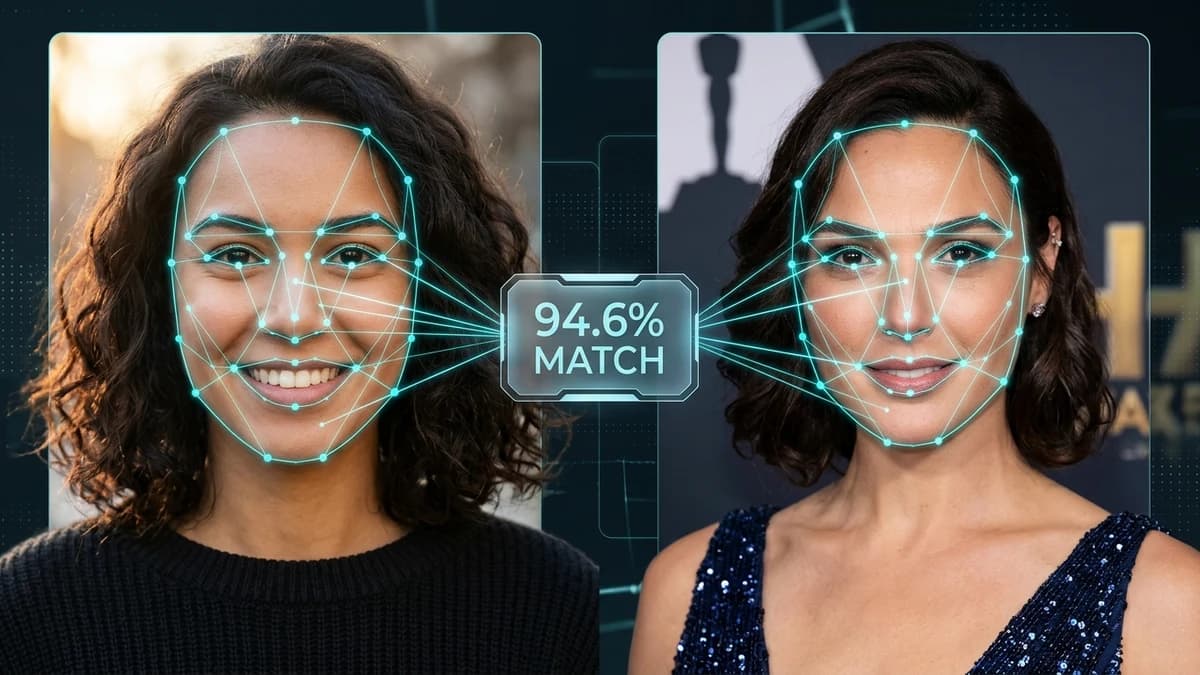
From 68 Facial Landmarks to Deep Vector Embeddings
Why Camera Lenses Distort Celebrity Resemblance
| Facial Anatomical Feature | Landmark Alignment Points | Relative Weight in Similarity Models | Sensitivity to Camera Angle & Lighting |
|---|---|---|---|
| Inter-Ocular Distance & Eye Cavities | Inner & outer canthi (eye corners) | Very High (25–30%) | Low sensitivity; bone structure remains stable |
| Nose Bridge & Nasal Width | Nasion, pronasale & subnasale coordinates | High (20–25%) | Moderate; highly sensitive to selfie lens focal distortion |
| Jawline Curvature & Chin Contours | Gonion angles and gnathion (chin tip) | High (15–20%) | High sensitivity to head tilt, weight changes & facial hair |
| Mouth Width & Philtrum Ratio | Cheilion (lip corners) and vermilion borders | Moderate (10–15%) | High sensitivity to smiling, laughing, and mouth expression |
| Cheekbone Prominence & Zygomatic Arch | Lateral facial contour coordinates | Moderate (10–15%) | Moderate; influenced by ambient directional lighting |
1:1 Face Comparison vs One-to-Many Doppelganger Search
Frequently Asked Questions
Can AI reliably tell which celebrity I look like?
AI calculates mathematical similarity between facial features (such as eye spacing, nose bridge shape, and jaw curvature). While it can identify celebrities with shared geometric bone structures, perceived resemblance is subjective and heavily influenced by hairstyle, charisma, and makeup.
Why do different face match apps give me different celebrities?
Different apps utilize different neural network models, training datasets, and feature weighting systems. Furthermore, variations in lighting, head tilt, and smile expressions between photos can alter vector coordinates significantly.
How do I take the best photo for celebrity face matching?
Use a photo taken in natural, diffuse lighting where your face is directly front-facing and free from heavy shadows. Maintain a neutral facial expression and keep the camera at eye level at least four to five feet away to minimize lens distortion.
Does a high similarity score mean we are related?
No. A high similarity score simply indicates that your facial landmarks and structural proportions align closely in vector space. True biological kinship requires genetic DNA testing.

Marcus Vance
Lead Biometric Security Analyst & Senior OSINT Researcher · TryFaceSearch Research Lab
Marcus Vance is a biometric security analyst and open-source intelligence (OSINT) specialist investigating facial recognition privacy, visual identity verification, and romance scam syndicates.