Fraud Prevention

Most Commonly Stolen Romance Scammer Photos & How to Verify Them
•Published: October 12, 2026•10 min read•Updated: October 23, 2026
Common romance scammer photo personas, stolen image evasion tactics, and verification

The Mechanics of Photo Hijacking in Romance Fraud

According to comprehensive enforcement advisories from the [FBI Internet Crime Complaint Center (IC3)](https://www.ic3.gov/Media/Y2023/PSA230314), the [Federal Trade Commission (FTC)](https://consumer.ftc.gov/articles/what-know-about-romance-scams), and [Europol's European Cybercrime Centre (EC3)](https://www.europol.europa.eu/about-europol/european-cybercrime-centre-ec3), romance fraud is rarely committed by lone amateur operators; it has developed into a multi-billion dollar industrial syndicate operation. Syndicates build hundreds of operational profiles simultaneously across Tinder, Hinge, Bumble, and Instagram. To establish immediate credibility and emotional resonance, syndicates harvest thousands of authentic, candid photos from public social media accounts belonging to real, attractive individuals. Scammers favor individuals whose profession provides a credible excuse for being physically inaccessible and unable to meet in person or conduct video chats. Soldiers deployed on foreign bases, surgeons in emergency wards, and maritime engineers stationed on offshore oil platforms are the perennial favorites of romance fraud operations.

How Scammers Modify Photos to Bypass Detection

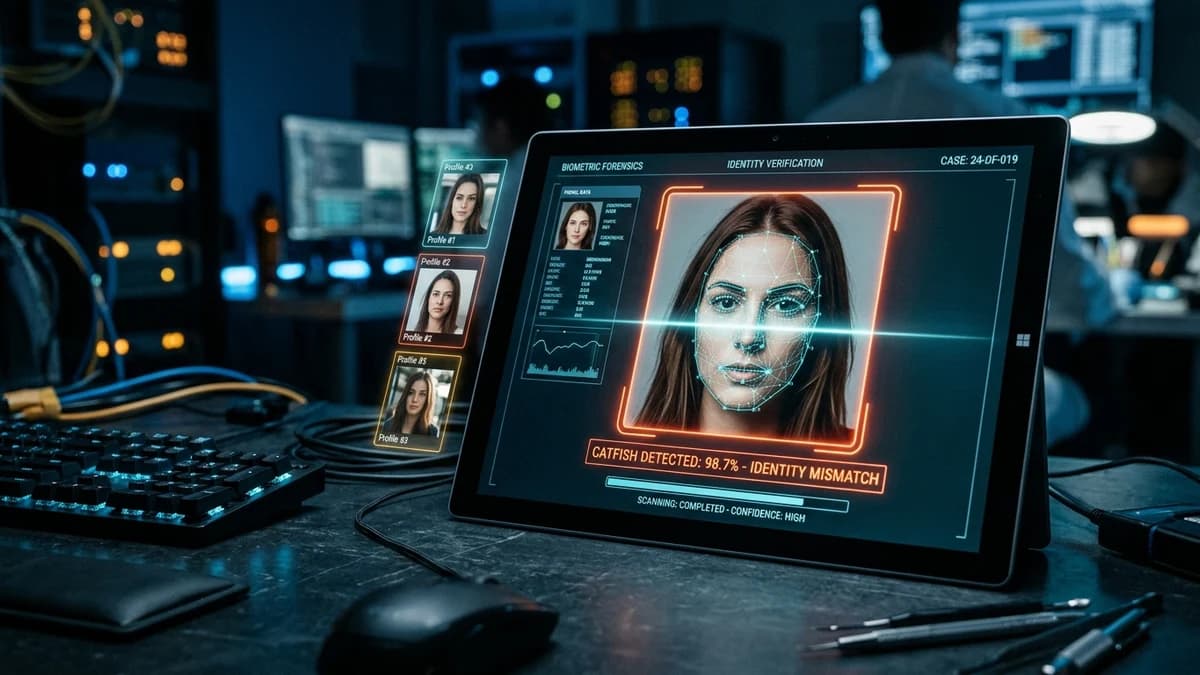
When victims become suspicious, their first instinct is often to run the profile photo through basic reverse image search tools like Google Images or TinEye. Anticipating this, scam syndicates employ systematic image manipulation tactics: 1. **Horizontal Flipping (Mirroring)**: Inverting the image from left to right alters pixel coordinate matrices, defeating simple convolutional edge detectors. 2. **Tight Cropping & Background Swapping**: Isolating the subject's face while removing distinctive background elements (such as city landmarks or identifiable uniform badges). 3. **Color Grading & Noise Injection**: Applying subtle vignette filters, altering saturation, or injecting slight pixel noise to shift digital file hash signatures. 4. **Screenshotting & Compression Cycles**: Capturing a smartphone screenshot of an existing image rather than saving the raw file, which strips camera EXIF metadata and introduces compression artifacts. While these manipulations degrade pixel-based comparison, they fail to disguise invariant biometric facial landmarks—which is why modern face search engines are indispensable for uncovering the original source.
Common Romance Scammer Personas & Behavioral Warning Signs
Persona ArchetypeTypical Stolen Photo SourcesCommon Fabricated BackstoryBehavioral Red Flags
Military Service MemberPublic military social media accounts & ceremony photosDeployed overseas in high-risk zones on peacekeeping missionsCannot conduct video calls due to 'classified operations'; requests emergency leave fees
Doctor / Trauma SurgeonMedical school graduations & hospital ward Instagram postsVolunteering with international humanitarian medical organizationsClaims bank accounts are frozen in foreign war zones; asks for medical supply loans
Oil Rig / Offshore EngineerMaritime industry profiles & offshore construction blogsWorking on remote drilling platforms in the North Sea or GulfUrgent equipment repair requests; immediate relocation to encrypted messaging apps
Luxury Lifestyle / Crypto InvestorEuropean luxury travel creators & fitness modelsIndependent financial entrepreneur or high-end architectIntroduces fraudulent crypto trading platforms; promises guaranteed investment returns
Widowed Single ParentFamily lifestyle bloggers & portrait photographersTragically lost spouse; raising a young child overseasAppeals to maternal/paternal empathy; requests child school tuition or medical emergency funds

Crucial Rule: The Person in the Photo Is an Innocent Victim

When your photo search reveals that a Tinder match is using the photos of an active-duty military sergeant, a French fitness model, or an American doctor, remember this vital fact: the person pictured is almost certainly not the person messaging you. They are a victim of identity theft whose likeness was stolen and abused without their knowledge. Never reach out to the real person on their public social media with angry or accusatory messages. Many creators receive dozens of daily messages from scam victims worldwide. Treat verified creators with empathy and direct your reporting to dating app moderation teams and law enforcement agencies.

Actionable Steps to Verify a Dating Match Safely

1. **Insist on Live Video Call**: Request an ordinary live video call within the dating app's built-in video platform early in communication. Any excuse involving broken cameras, military bandwidth restrictions, or hospital regulations is an immediate warning sign. 2. **Run a Biometric Photo Lookup**: Upload their profile picture to TryFaceSearch to identify whether that face is linked to a verified creator or different name. 3. **Never Transfer Money or Cryptocurrency**: Under no circumstances should you wire funds, buy gift cards, or invest in recommended cryptocurrency portals for someone you have never met face-to-face.

Frequently Asked Questions

Why do scammers always refuse to video call?

Scammers refuse video calls because they are usually operating from international call centers and do not physically resemble the stolen photographs on the profile. They often claim poor internet connection, strict military regulations, or broken camera hardware.

Can scammers use AI deepfakes during video calls?

While real-time AI deepfakes are advancing, they remain technically difficult to maintain over natural video interactions. You can test for a live deepfake by asking the person to wave their hand in front of their face, turn sideways to reveal their profile, or hold up three fingers; real-time face generation models frequently glitch under rapid occlusion.

What should I do if I confirm my match is using stolen photos?

Cease all communication immediately. Do not confront the scammer, as this teaches them how to improve their deception. Screenshot the conversation, document their profile URL, and report the account directly to the dating app's moderation team.

How does TryFaceSearch detect stolen photos that have been cropped?

TryFaceSearch evaluates structural biometric coordinates—such as the ratio between eye pupils, nose bridge width, and jaw contour. Because these anatomical landmarks remain stable regardless of background cropping or mirroring, the system can match modified images back to public sources.

Marcus Vance
Written By

Marcus Vance

Lead Biometric Security Analyst & Senior OSINT Researcher · TryFaceSearch Research Lab

Marcus Vance is a biometric security analyst and open-source intelligence (OSINT) specialist investigating facial recognition privacy, visual identity verification, and romance scam syndicates.

Related Face Search Tools & Guides